A tiny yet lively town in sun-drenched sand, Barmer is a miniature Rajasthan with all its colour, warmth and tradition. According to history, the 13th-century founder of the district, Bhahada Rao (popularly known as Bar Rao) gave the town its name - Barmer, i.e., the hill fort of Bar, once called Mallani (12th century A.D.). The present Barmer district, formed in 1949 upon the merger of Jodhpur state in the United States of Great Rajasthan, is a cluster of ancient paraganas - Mallani Shiv, Pachpadra, Siwana and the Chohatan area. Although a barren land with harsh climate and rough terrain, Barmer is known for its rich crafts, dances, and music. Once on the ancient camel trade route, the town is now a centre for wood carving, pottery, carpets, intricate embroidery work, block printed fabrics and multi-hued traditional costumes. Especially famous are the geometric ajrak prints in dark shades of red and blue, ideal for protection against the sun. The most interesting part of a trip to Barmer is the journey through rural Rajasthan. The small villages with mud-walled houses decorated with delicate folk motifs and colourfully attired people on the way offer a fascinating sight. Every year in March, the desert town is at its colourful best during the exuberant Barmer Festival. The festival is the best time to plan a visit to Barmer.
Origin of Name
In earlier times, the district was known by the name "Mallinath" (मल्लिनाथ). Mallinath was the son of Rao Salkha and Mallinath is a God who is still worshiped by Rajputs. The whole area around the river "Luni" was said to have "Malani" or "मलानी", derived from the name Mallinath. In the 18th century the name "Barmer" or "Balmer" was adopted by the British rulers of India and is derived from the name of the earlier 13th-century ruler Bahada Rao Parmar (Panwar) or Bar Rao Parmar (Panwar), it was named Bahadamer ("The Hill Fort of Bahada").
Demographics
As per census of the 2011 India, District Barmer had a population of 2,603,751 of which male and female were 1,369,022 and 1,234,729 respectively. The population of the 0-6 year age range is 22% in proportion to the total population of the district. Barmer had an average literacy rate of 56.53%, with 70% of the males and 40% of females being literate.
Tourism
The city is home to a goddess temple (Jagatambe MAA), which lies in the mountains at a height of approx 450 feet (140 m) and was built around 500 years ago. The oldest Jain temple in the city is "Chintamani Parshvanath" (चिंतामणि पार्श्वनाथ). Built by Shri Nemaji Jivaji Bohra in the 16th century, it is located at Mountain Hill at a height of 150 feet (46 m). The temple is well furnished with glass work and images and is said to be identical to the "Gaudi Parsvanath" (can be compared with the Jain temple in Mumbai).
Some 12 kilometres (7.5 mi) west of the town lie the remains of Juna or Juna Barmer, the headquarters of Barmer prior to the 16th century. In Juna there are the ruins of three Jain temples. There is an inscription dated 1295 AD on one of the pillars of the hall of the largest temple at Juna. This mentions that the state was rich in Jain population at the time. Nowadays, the Jain population has shifted to Barmer city. History mentions a Maharajakula Sri Samanta Sinha Deva ruling Barmer at the time. The temple now lacks an image of God.
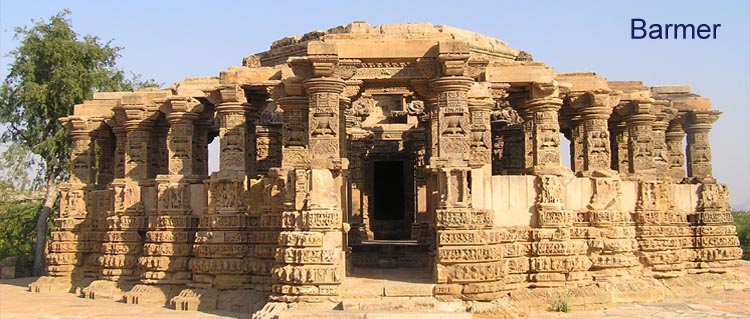
To the Northwest, there is a beautiful old ruined temple of Lord Shiva in Keradu or Kherdhar or Keralu which might have been constructed before the 6th century at the time of the "Parmar" Dynasty. There are 4-5 Big Temple structures of Golden colour and a Sun Temple. The temple is well entitled as the "Khajuraho of Rajasthan". The design of the temple is identical to the Khajuraho Temple and Sun Temple at Orissa. The temple is in ruins and lacks images of Gods and Goddesses. Keradu was the earlier Headquarter of Barmer and it was attacked by Mohammad Gauri in 1140 AD who destroyed the temple structure and its images.
Barmer is noted for its camel milk, large cattle fair (Tilwara), carved wooden furniture, hand block printing, handicrafts, woolen industries, and guar industries among others.
Barmer is the biggest crude oil producer in India with a production capacity of approx 3 Lac Barrels/Day. A refinery of 9mppd is planned 100 kilometres (62 mi) from Barmer in Pachpadra. The major festival in the town is the Barmer Thar Festival, started as a practice to enhance the tourism potential of this town. During the annual Barmer festival in March, the town is at its colourful best and that is the best time to visit Barmer.